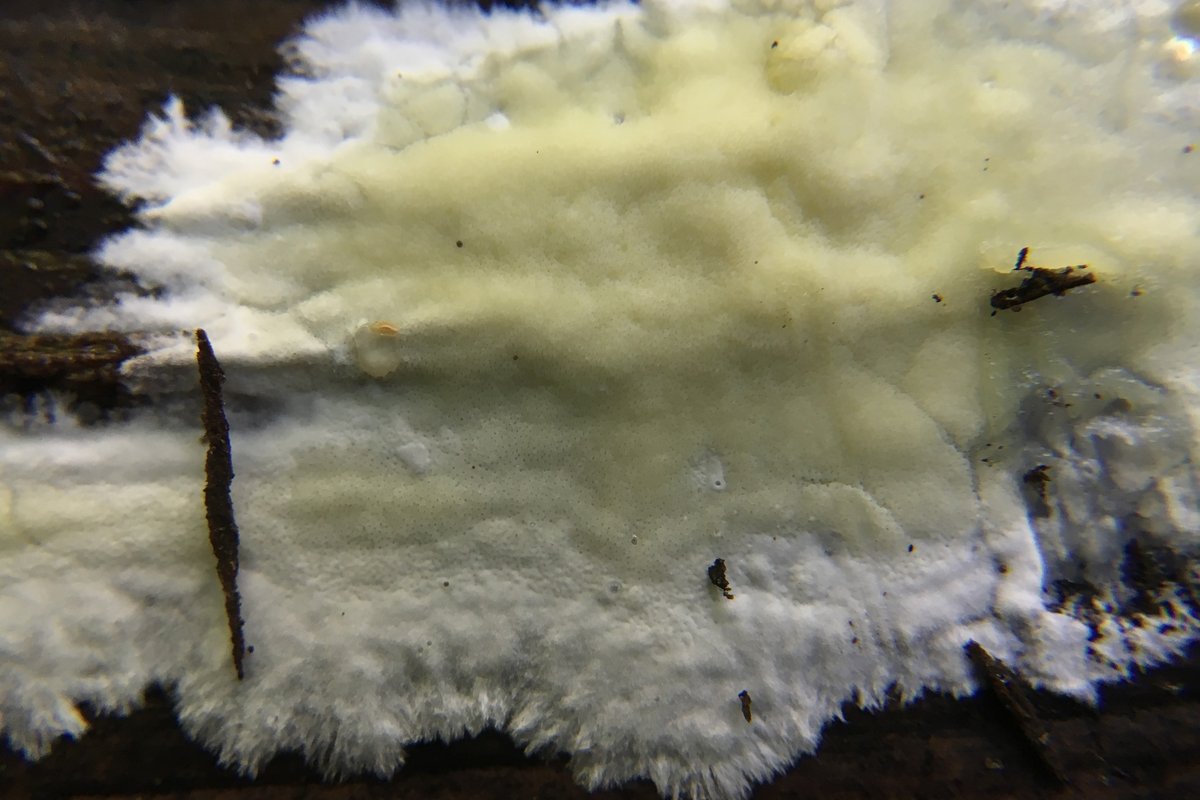
Basidiome with yellow hymenium and white margin (Alden Dirks, iNat172514532)

Basidiome from further away (Alden Dirks, iNat172514532)

Basidiome with greenish hues (Maricel Patiño, iNat143236600)

Basidiome (Tom Bigelow, iNat181655038)

Basidiome (Huafang Su, iNat241989241)

Basidiome (John Plischke, iNat320903504)

Drawing of microscopic features of Gloeoporus pannocinctus (Figure 3, Niemelä 1985)

Basidium

Narrow, allantoid basidiospores

Subhymenial hyphae

Thick-walled subicular hyphae
Luteovirente Porecrust
Gloeoporus pannocinctus (Romell) J. Erikss.


A distinct species, the resupinate polypore Gloeoporus pannocinctus can be identified by its gelatinous consistency, ease by which it can be peeled from the substrate, small pores, yellowish to yellow-green hymenium contrasting with a smooth to fimbriate white margin, and under the microscope, very narrow, allantoid spores.
"Gloeoporus" derives from the Greek word gloios meaning "gelatinous, viscid, sticky". The species epithet "pannocinctus" is composed of the Latin word pannus meaning "a peice of cloth, rags, a garment" and cinctus, Latin for "banded, girdled" (Jaeger 1978). While not explicitly stated, the original species description implies this refers to the white fimbriate margin, which forms a "ragged band" around the crust (Romell 1911).
Across the internet, Gloeoporus pannocinctus is also known as "green porecrust", a common name that strikes me as a misnomer. Gloeoporus pannocinctus is predominantly pale yellow, ranging from whitish to slightly olivaceous (yellow green). It's never as green as "green porecrust" implies to me, which is why I'm instead calling it "luteovirente porecrust". This comes from the original Latin description in which it was characterized as "hymenium subcremeum, tinctura levissima luteovirente" or "hymenium subcream, very light yellow-green tint" (Romell 1911).
Gelatoporia pannocincta is a synonym.
Details
White-rot saprotroph of fallen trunks, preferably large ones, primarily angiosperms but occassionaly conifers (Niemelä 1985).
Resupinate, effused, with a typically pale yellow (ranging from whitish to lightly yellow-green) hymenium, poroid hymenophore with a gelatinous consistency. Margin distinct, white, smooth to fimbriate. Reportedly, a dark line is present under the pore layer, but I have not observed this personally.
Stinky mushroomy smell with a sweet/spicy chemically quality, maybe radishy or like soy sauce, somewhat repugnant. Taste reported as slightly bitter (Gibson 2020).
Not determined.
White.
Boreal, temperate, and tropical Northern Hemisphere (North America, Europe, and Asia), potentially globally distributed. See all sequenced observations on iNaturalist.
Microscopy
Hyphal system: Monomitic, clamped, subicular hyphae thick-walled, 3–5 µm wide, subyhmenial hyphae thin-walled, 2.5–3.5 µm wide. Basidia: Few observed although basidiospores extremely abundant, about 14 ✕ 3 µm with four sterigmata approximately 1.5 µm long. Basidiospores: Inamyloid, hyaline, allantoid to fusiform, curved, length (3.4) 3.7–4.2 (4.5) µm, width (0.5) 0.7–1.0 (1.2) µm, x̄ = 4.0 ✕ 0.8 µm; Q (3.5) 4.3–5.8 (6.5), x̄ = 5.0 (n = 30 per specimen). Sterile structures: Absent.
Studied Specimens
ACD0164 (iNat172514532). Collected by Alden C. Dirks. 7 June 2019. University of Wisconsin-Madison Arboretum, Dane Co., WI, USA, 43.0436, -89.4327. ACD Personal Collection. Sequences: MZ919168 (ITS).
ACD0691 (iNat143236600). Collected by Maricel Patiño. 24 November 2022. Burlington Co., NJ, USA, 40.0359, -74.9818. ACD Personal Collection. Sequences: OR680680 (ITS).
References
-
Gibson I. 2020. Gloeoporus pannocinctus (Romell) J. Erikss. In Klinkenberg B (Editor). 2020. E-Flora BC: Electronic Atlas of the Plants of British Columbia [eflora.bc.ca]. Lab for Advanced Spatial Analysis, Department of Geography, University of British Columbia, Vancouver. Accessed: 2026-04-02. Link
-
Jaeger EC. 1978. A Source-Book of Biological Names and Terms. Springfield, Illinois, USA: Charles C. Thomas, Bannerstone House. 360 p.
-
Jung PE, Lee H, Wu S-H, Hattori T, Tomšovský M, Rajchenberg M, Zhou M, Lim YW. 2018. Revision of the taxonomic status of the genus Gloeoporus (Polyporales, Basidiomycota) reveals two new species. Mycological Progress 17:855–863. PDF Link
-
Niemelä T. 1985. On Fennoscandian polypores 9. Gelatoporia n. gen. and Tyromyces canadensis, plus notes on Skeletocutis and Antrodia. Karstenia 25:21–40. Link
-
Romell L. 1911. Hymenomycetes of Lappland. Arkiv För Botanik 11:1–35. Link
Citation
Dirks, Alden. 2026. Species profile for Gloeoporus pannocinctus (Romell) J. Erikss. CrustFungi.Com. https://crustfungi.com/species/gloeoporus-pannocinctus/. Accessed 2026-04-04.