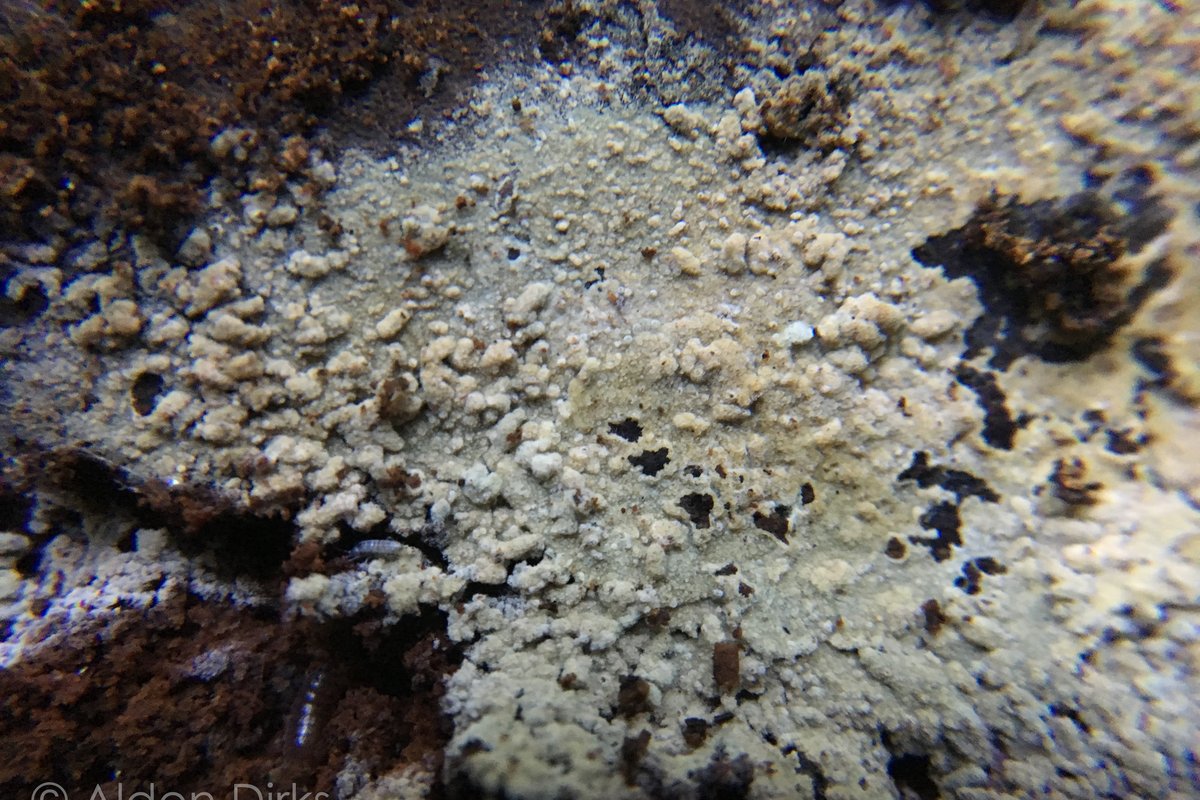
Subceraceous basidiocarp

Substrate

Hymenophore consisting of thick-walled pseudocystidia arising from skeletal hyphae adorned with spiky crystal balls

Bundled pseudocystidia

Spiky crystal ball

Longitudinally septate basidium

Basidiospores

Repetitive basidiospores
Protomerulius minor (Möller) Spirin & Miettinen


If you encounter a crust with septate basidia, there's good news and bad news. The good news is that your options dwindle considerably to species in the orders Auriculariales, Cantharellales, and Sebacinales (assuming it's not actually a jelly fungus in the Dacrymycetes or Tremellomycetes, or even something like Septobasidium in the subphylum Puccionomycotina). The bad news is that these are all difficult orders to work with and no comprehensive keys exist for species-level identification.
Promotmerulius species posess a diagnostic crystalline structure — bizarre spiky crystals that look like microscopic medieval weapons. Crystals appear in such diverse forms across so many crusts. Why does one species coat its hyphae in sharp needle crystals or blocky chunky ones, another produce crystal enshrouded lance-shaped cystidia, and yet another make giant spiky balls? The chemical control of these fungi over the growth of crystals is exquisite, but to my knowledge we have no idea how or why they do this.
Like many crusts, we know basically nothing about this species except for its taxonomy and morphology. Protomerulius minor appears to be widely distributed in the Americas, from Brazil northwards to the United States.
Details
Wood-decay saprotroph, rot type unknown.
When young, whitish to cream-colored, later greyish to ochraceous; hymenophore effused, smooth to finely reticulate or minutely granulose due to projecting skeletal hyphae, pruinose to byssoid (floccose) to subceraceous in texture; margin indeterminate, gradually thinning out.
Not determined.
Not determined.
White.
Described from Brazil, Protomerulius minor is found throughout North and South America. View all sequenced specimens on iNaturalist.
Microscopy
Hyphal system: Dimitic, generate hyphae and skeletal hyphae; reported as clamped, but very difficult to observe; very prominent and characteristic (for the genus) spiky crystal balls (stellate agglomerations) present throughout the basidiocarp, up to 24 µm across. Basidia: Cruciate (longitudinally septate heterobasidia), sphaeropedunculate (ellipsoid to subglobose basidia with a stalk), with four sterigmata per basidium; length (9.2) 9.7–12 (13) µm (length may include stalk, difficult to differentiate), width (5.6) 5.9–7.4 (7.9) µm, x̄ = 10.8 ✕ 6.6 µm (n = 10); sterigmata length (3.7) 4.8–8.2 (9) µm (n = 10). Basidiospores: Ellipsoid to cylindrical with a flattened adaxial side, smooth, thin-walled, inamyloid, acyanophilous, repetitive; length (6) 6.3–7 (7.5) µm, width (3.7) 3.9–4.2 (4.4) µm, x̄ = 6.6 ✕ 4.1 µm, Q (1.5) 1.5–1.7 (1.9) (n = 30). Sterile structures: Thick-walled pseudocystidia (tramal cystidia) arising from the skeletal hyphae, typically wrapped around each other and bundled together in fascicles as they project beyond the hymenium in the center of minute "teeth" or mounds (giving the basidiocarp its granulose to hydnoid appearance), becoming thin-walled and sometimes tapering at the apex and forming bristle-like tips; up to hundrds of microns long, width 3.0–4.5 (5.9) µm (n = 10).
Studied Specimens
ACD0184 (iNat33478375). 24 September 2019. Ann Arbor, Washtenaw Co., MI, USA, 42.2951 -83.7243. University of Michigan Fungarium (MICH352189). Sequences: MZ919178 (ITS).
References
-
Spirin V, Malysheva V, Miettinen O, Vlasák J, Alvarenga RLM, Gibertoni TB, Ryvarden L, Larsson K-H. 2019. On Protomerulius and Heterochaetella (Auriculariales, Basidiomycota). Mycological Progress 18:1079–1099. PDF Link
Citation
Dirks, Alden. 2026. Species profile for Protomerulius minor (Möller) Spirin & Miettinen. CrustFungi.Com. https://crustfungi.com/species/protomerulius-minor/. Accessed 2026-04-04.