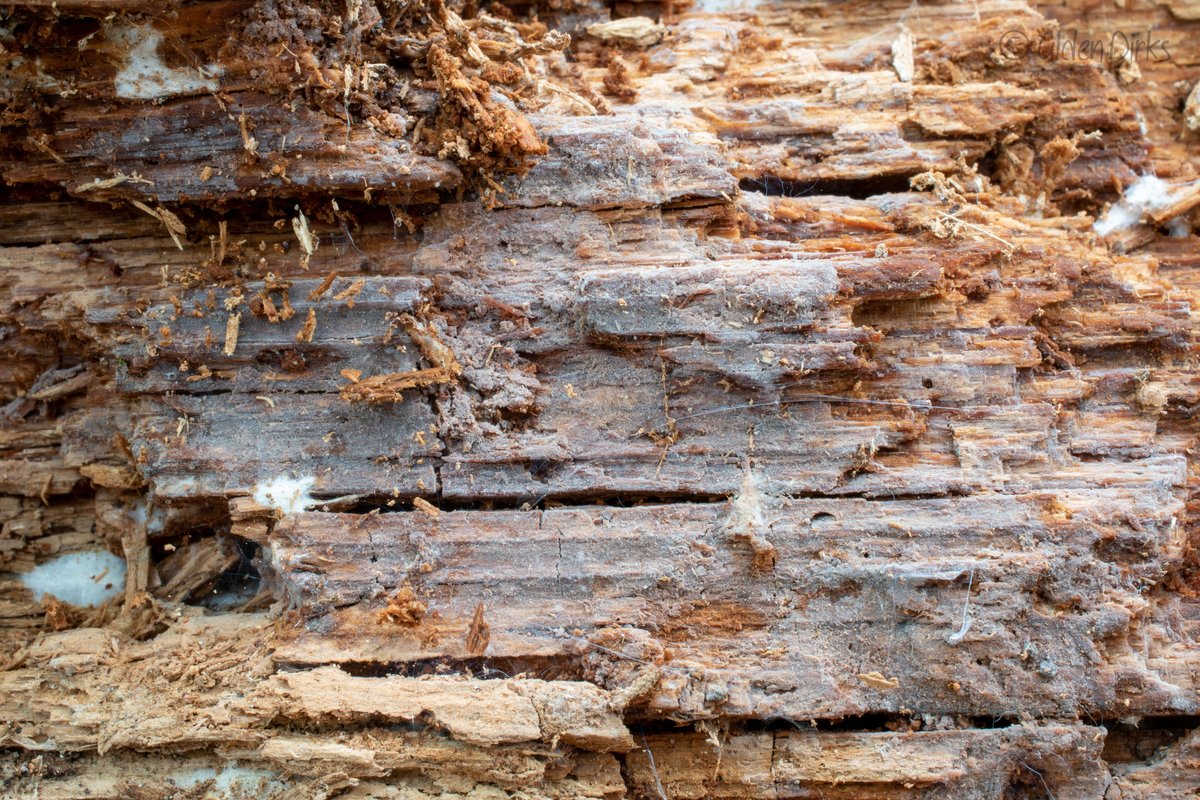
Basidiocarp

Small basidiospores

Lyocystidia in KOH stained with phloxine, showing the very thick walls that abruptly narrow at the tip to form a capitate head

Closer look at the resinous material coating the lyocystidia heads (visible in water, dissolving in KOH)
Tubulicrinis accedens (Bourdot & Galzin) Donk


Tubulicrinis species (as well as Dextrinocystis spp., Litschauerella spp., and Tubulicium spp.) possess distinct sterile structures called lyocystidia composed of very thick walls and a thin central lumen that may open abruptly at the apex to form a thin-walled head. Lyocystidia can by bi- or multi-rooted and are sometimes heavily encrusted or covered in anemone-like hyphae (Bernicchia and Gorjón 2010, Hjortstam et al. 1973). Bizarre!
There are about 46 species in the genus Tubulicrinis, with Tubulicrinis glebulosus serving as the type species (He et al. 2020). Like far too many crusts out there, Tubulicrinis is sadly understudied beyond the basic taxonomic work that brought the group's species concepts into existence in the first place.
Regarding Tubulicrinis accedens, the specific epithet comes from the Latin word accedere meaning "to approach". This fungus was first described as a subspecies, Peniophora glebulosa subsp. accedens, which suggests that accedens refers to an appearance "approaching" that of Peniophora glebulosa (≡ Tubulicrinis glebulosus). Without that context, though, the name doesn't really say much, and even after knowing it, who cares? Let's revise history and say that "accedens" is a descriptor for how this fungus approaches our heart, filling us with love and gratitude for how great crusts are.
There are a number of Tubulicrinis species that are differentiated by small differences in basidiospore size, lyocystidium neck constriction and encrustation, and degree of amyloidy of the basidia and lyocystidia. Most species do not have sequence data. It would not surprise me if this specimen and others from North America represent undescribed species.
Details
Presumably saprotrophic on downed coniferous wood. The documented specimen was found on the bottom of a fallen, barkless Pinus strobus (white pine) trunk.
Thin, effused, smooth, with a pruinose to arachnoid consistency and abrupt, undifferentiated margin, whitish to lilac grey in color.
Not determined.
Not determined.
White.
Widely distributed across temperate North America and Europe according to MyCoPortal records, although this is the only sequenced specimen in GenBank.
Microscopy
Hyphal system: Monomitic, clamped, 1.5–3 µm wide. Basidia: Subclavate to conical, small, terminal, with four sterigmata and a basal clamp; length (7.9) 8.8–12.5 (15.2) µm, width (4.2) 4.3–4.9 (5) µm, x̄ = 10.7 ✕ 4.6 µm (n = 10). This length is likely an underestimate because the basidia were difficult to fully see. Basidiospores: Ellipsoid to cylindrical, inamyloid, smooth, thin-walled, hyaline; length (3.5) 3.9–4.6 (4.9) µm, width (2.3) 2.6–3 (3) µm, x̄ = 4.2 ✕ 2.8 µm; Q (1.2) 1.4–1.7 (1.8), x̄ = 1.5 (n = 30). Sterile structures: Lyocystidia very abundant, birooted, consisting of a thick wall that narrows abruptly at the apex to form a globose tip; the globose head, and to a lesser degree the neck, are covered by a somewhat amorphous, chunky, resinous substance that dissolves in KOH; length (37.4) 42.0–50.2 (50.8) µm, basal width (3.2) 3.3–4.0 (4.4) µm, x̄ = 46.1 ✕ 3.7 µm (n = 10).
Studied Specimens
ACD0414 (iNat78264072). 10 May 2021. Saginaw Forest, Washtenaw Co., MI, USA, 42.2770 -83.8068. University of Michigan Fungarium (MICH352299). Sequences: OL756001 (ITS), OL742444 (LSU).
References
-
Bernicchia A, Gorjón SP. 2010. Corticiaceae s.l. Italia: Candusso. 1008 p. Link
-
He X, Shi Z-J, Zhao C-L. 2020. Morphological and molecular identification of two new species of Tubulicrinis (Hymenochaetaceae, Hymenochaetales) from southern China. Mycoscience 61:184–189. PDF Link
-
Hjortstam K, Larsson K-H, Ryvarden L. 1973. The Corticiaceae of North Europe Volume 1: Introduction and Keys. Oslo, Norway: Fungiflora. Link
-
Hjortstam K, Larsson K-H, Ryvarden L. 1988. The Corticiaceae of North Europe Volume 8: Phlebiella, Thanatephorus — Ypsilonidium. Oslo, Norway: Fungiflora. Link
Citation
Dirks, Alden. 2026. Species profile for Tubulicrinis accedens (Bourdot & Galzin) Donk. CrustFungi.Com. https://crustfungi.com/species/tubulicrinis-accedens/. Accessed 2026-04-04.