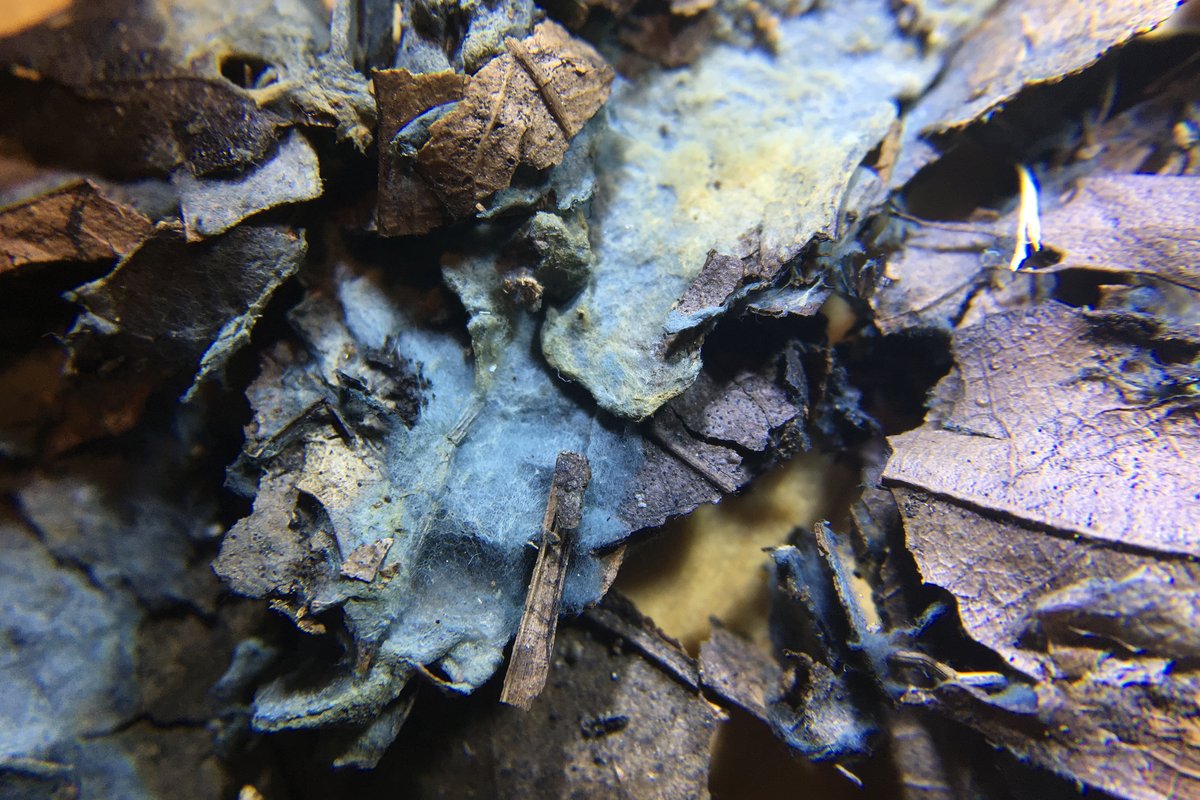
Basidioma

Basidioma (Huafang Su, iNat186482891)

Basidioma (John Plischke, iNat139448503)

Blue-green hyphae (tap water)

Hyphae with coarse texture

Small, subglobose, apiculate, and guttulate basidiospores

Cyanophilic basidiospores

Two-sterigmate basidia

Finger-like hyphidia

Finger-like hyphidia
Blue Cotton Crust
Byssocorticium sp. 'atrovirens-IN01'
Blue is the rarest color in nature. So, why are Byssocorticium crusts, hidden under branches and leaf debris, blue? I wish I had a compelling answer, but unlike ornithology where color science is a respected and well established field, there has been essentialy no research on the evolution or adaptive function of mushroom color. It makes me so blue.
Byssocorticium sp. 'atrovirens-IN01' is a temporary name for an American (in a broad sense, see Distribution below) species that is closely related to, but distinct from, the European Byssocorticium atrovirens. This is not too surprising: there is a well-documented pattern of cryptic differentiation between closely related European and North American taxa. Many species in the Americas were historically identified under European names, but detailed morphological study and DNA sequencing have repeatedly demonstrated that they represent distinct evolutionary lineages. And some — like Byssocorticium sp. 'atrovirens-IN01' — still require their own name.
Telltale signs that you have a Byssocorticium species include a blue coloration, a byssoid or loose, felt-like texture, and hyphae that branch at right angles. In the absence of DNA barcode data, species identification is currently a guessing game. The genus consists of eight described species (Wijesinghe et al. 2025), but the ITS data show 20 or more species-level clades, and it's not always certain which populations the described species correspond to. A modern taxonomic study of Byssocorticium is desperately needed.
Even though Byssocorticium species grow on the bottom of plant debris, they are actually ectomycorrhizal — the wood and leaves are just a platform for sporocarp production (Tedersoo et al. 2010).
Details
Mycorrhizal, host range not determined, growing on the underside of wood debris.
Effused, even, byssoid, chalky grey blue with yellowish patches.
Not determined.
Not determined.
Not determined.
Documented from northern regions of the Midwest and Northeast United States as well as Belize. View all sequenced specimens on iNaturalist
Microscopy
Hyphal system: Monomitic, blue-green, subicular hyphae with simple septa, 2.5–3.5 µm wide (n = 10), branching at right angles, with a coarse texture not dissolving in KOH. Basidia: Terminal, clavate, length (17.2) 17.7–20.6 (21.3) µm, width (3.7) 4.0–5.2 (5.4) µm, x̄ = 19.1 ✕ 4.6 µm (n = 10), with two or four sterigmata, length (1.1) 1.9–3.3 (5.4) µm, x̄ = 2.6 µm (n = 10), occasionally with a basal clamp, often filled with oil droplets. Basidiospores: Smooth, thick-walled, hyaline, inamyloid, cyanophilous cell wall, subglobose to broadly ellipsoid in form, pyriform in shape with a tapered apiculus; length (3.5) 3.8–4.4 (5.1) µm, width (3.2) 3.4–4.0 (4.4) µm, x̄ = 4.1 ✕ 3.7 µm, Q (1.0) 1.0–1.2 (1.4), usually with a single large guttule occupying 60–80% of the spore cytoplasm (n = 30). Sterile structures: Cystidia absent, hyphidia finger-like as in Tretomyces lutescens.
Studied Specimens
iNat17333142. 06 October 2018. 5304 Reeve Rd., Dane Co., WI, USA, 43.1458 -89.8114. Kriebel Fungarium (PUL00042321). Sequences: MN989989 (ITS).
References
-
Tedersoo L, May TW, Smith ME. 2010. Ectomycorrhizal lifestyle in fungi: global diversity, distribution, and evolution of phylogenetic lineages. Mycorrhiza 20:217–263. PDF Link
-
Wijesinghe SN, Deng YL, Yuan Q, Zhou HM, Wang L, Dai YF, Xu Y, Jiang N, Al-Otibi F, Al-Sadi AM, Cao B, Chen Q, De Silva NI, Dong JH, Dong W, Du TY, Gu ZR, He SY, Jiang QQ, Li F, Li Q, Li W, Liu P, Liu WX, Liu XY, Liu ZB, Lu WH, Maharachchikumbura S, Su JQ, et al. 2025. Mycosphere Notes 572-624: exploring the hidden diversity of fungi and fungilike taxa in different terrestrial microhabitats. Mycosphere 16:2975–3129. Link
Citation
Dirks, Alden. 2026. Species profile for Byssocorticium sp. 'atrovirens-IN01'. CrustFungi.Com. https://crustfungi.com/species/byssocorticium-sp-atrovirens-IN01/. Accessed 2026-01-11.