
Effused-reflexed basidiocarp and smooth to tuberculate hymenophore

Orbicular fruiting bodies fuse over time to become effused-reflexed

Pendulate form (Ethan Crenson, iNat287364654)

Pileate basidiocarp (Huafang Su, iNat195053702)

Pileate basidiocarp (Huafang Su, iNat195053702)

Hymenium (Huafang Su, iNat189076207)

Abhymenial surface (Huafang Su, iNat189076207)
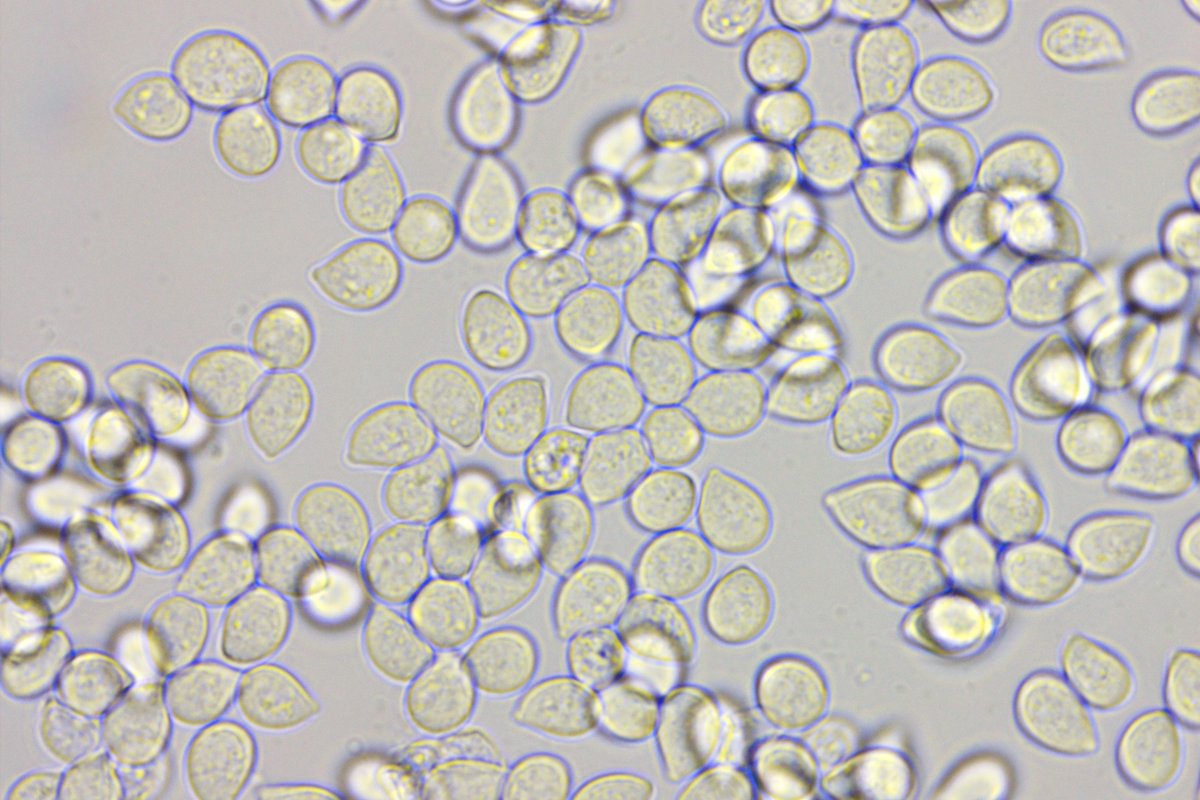
Lacrymoid basidiospores
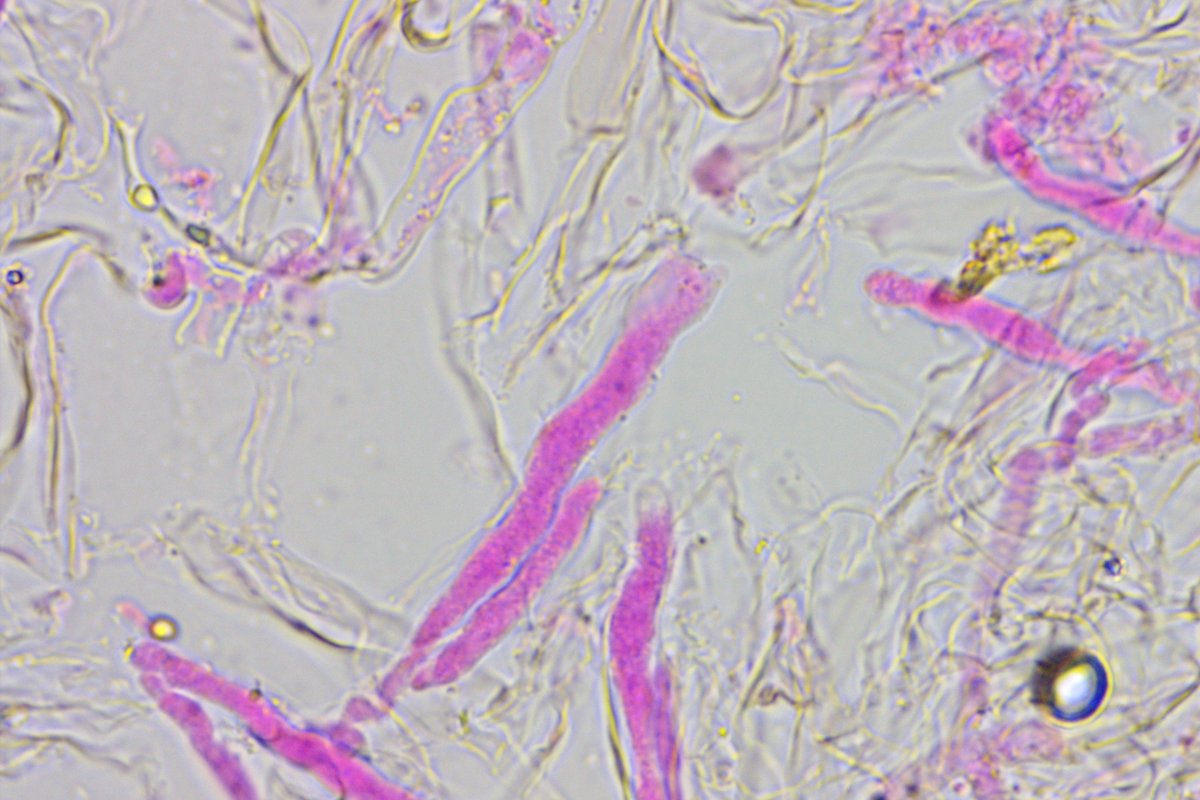
Long cylindrical basidia

Abundant oil droplets in the cytoplasm of the hyphae
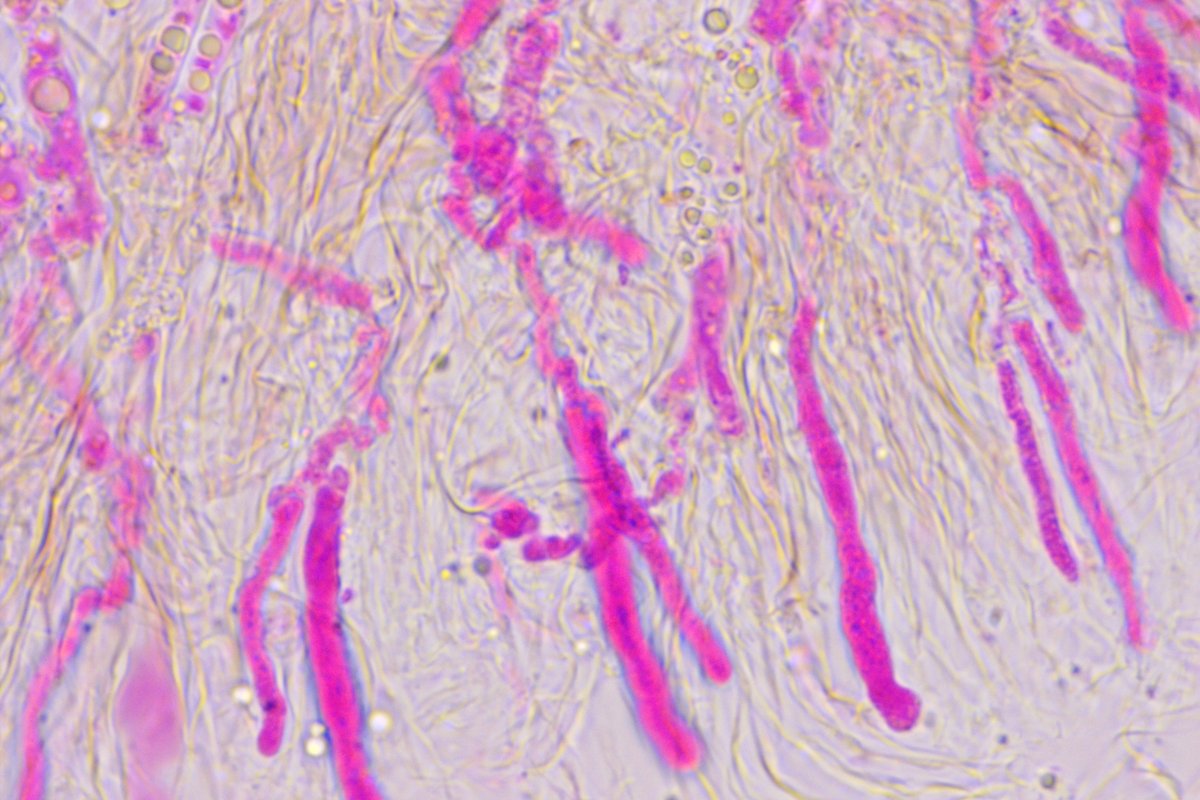
Densely packed hyaline tissue (perhaps spent basidia) crowd the hymenium

Clamp connections
Cylindrobasidium evolvens (Fr. ex Fr.) Jülich


This common and widespread saprotrophic crust is actually closely related to gilled mushrooms, a prime example of the rapid evolution of fungal morphology. Due it its global distribution and variable morphology (effused, orbiculate, effused-reflexed, or with a well-developed pileus), the same species has been described under many different names, resulting in a complicated taxonomic history. For example, Cylindrobasidium evolvens sometimes takes on a pendulate or "cucullate" (hooded) form, particularly in the winter, which was originally described as the rare Cladoderris minima Berk. & Broome in 1878 before being recognized as Cylindrobasidium evolvens by Reid in 1959 (Mattock 2014). If you want the full details, Jülich (1974) recounts his exploration of the nomenclatoral crypts and catacombs filled with centuries-old specimens and archaic Latin descriptions. Being sanctioned by Fries, he concludes that Cylindrobasidium evolvens ("evolvens" means unfolding in reference to its effused-reflexed growth) is the appropriate binomial for this species and that many other names, including the commonly used Cylindrobasidium laeve ("laeve" means smooth), are synonyms. Cylindrobasidium sp. 'evolvens-IN01' is a provisional species name in use for North American populations, but I believe Cylindrobasidium evolvens is a single widely distributed species and not a species complex.
For a time, researchers were excited about the prospect of using Cylindrobasidium evolvens as a biocontrol agent of Acer macrophyllum (bigleaf maple), which is treated as a weed in Pacific Northwest conifer plantations. Although Cylindrobasidium evolvens is closely related to the destructive plant pathogenic genus Armillaria, it failed to check the growth of bigleaf maple trees, suggesting it is truly just a saprotroph (Purewal 2004).
Details
Saprotrophic on hardwood branches and trunks, commonly growing on vertical substrates.
Soft and membranaceous basidiome; orbicular, resupinate, effused-reflexed with a small pileus, or pendulate (cucculate) with a well-developed pileus; effused crust margin white, fimbriate; cap tomentose and brown, slightly zonate, margin white; hymenium smooth to tuberculate, ranging from cream colored to peachy taupe or taupe to vinaceous bown or dark brown, sometimes showing concentric tuberculate growth patterns, cracking when dry or in age.
Not determined.
Not determined.
Whitish to pale cream.
Globally distributed with sequenced records from temperate North America, Asia, Europe, Africa, and New Zealand. View all sequenced specimens on iNaturalist.
Microscopy
Hyphal system: Monomitic, thin-walled, all septa with clamp connections; width (3.6) 3.6–4.8 (5.4) µm, x̄ = 4.2 µm (n = 10); oily inclusions common in subicular hyphae. Basidia: Terminal, narrowly clavate to cylindrical with four sterigmata and a basal clamp, often arising from small, squiggly hyphae; reported as 40–50 ✕ 5–6 µm. Basidiospores: Ellipsoid in dimension, lacrymoid in form; hyaline, inamyloid, without guttules; length (7.3) 7.8–9.2 (10.4) µm, width (5.4) 5.8–6.9 (7.9) µm, x̄ = 8.5 ✕ 6.4 µm; Q (1.2) 1.3–1.4 (1.6), x̄ = 1.3 (n = 30). Sterile structures: Leptocystidia present, but not so distinct from probasidia; reported as 50–80 ✕ 5–8 µm, fusiform, thin-walled, not encrusted, enclosed or slightly projecting beyond hymenium.
Studied Specimens
ACD0242 (iNat40928787). 27 March 2020. Ott Biological Preserve, Calhoun Co., MI, USA, 43.3142 -85.1218. University of Michigan Fungarium (MICH352229). Sequences: ON364080 (ITS), ON369533 (LSU).
References
-
Bernicchia A, Gorjón SP. 2010. Corticiaceae s.l. Italia: Candusso. 1008 p. Link
-
Jülich W. 1974. The genera of the Hyphodermoideae (Corticiaceae). Persoonia 8:59–97. PDF
-
Mattock G. 2014. Growth forms of Cylindrobasidium laeve. Field Mycology 15:42–44. PDF Link
-
Persoon CH. 1794. Neuer Versuch einer systematischen Eintheilung der Schwämme. Neues Magazin Für Die Botanik 1. PDF Link
-
Purewal D. 2004. Cylindrobasidium laeve for suppression of regrowth of Acer macrophyllum. Master of Pest Management. Simon Fraser University. PDF Link
Citation
Dirks, Alden. 2026. Species profile for Cylindrobasidium evolvens (Fr. ex Fr.) Jülich. CrustFungi.Com. https://crustfungi.com/species/cylindrobasidium-evolvens/. Accessed 2026-04-04.