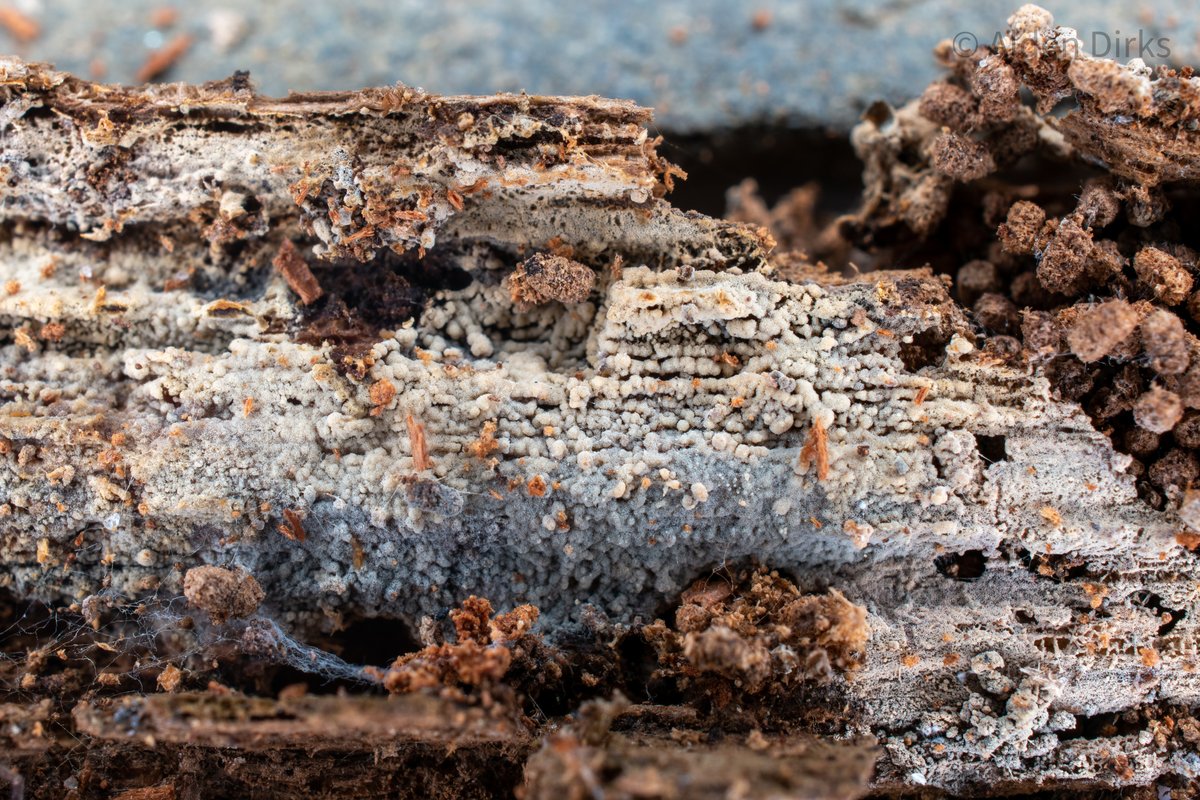
Bluish grey hues are evident in bright light upon close inspection

Basidiocarp

Basidiocarp

The same specimen from a natural distance

Thin basidiome up to 150 µm thick

Thin, monomitic hyphae

Pleurobasidia

Pleurobasidia

Subglobose to broadly ellipsoid spores

Ornamentation was more visible when the basidiospores were trapped in an air bubble
Xenasmatella sp. 'NJ01'
This likely undescribed species has been assigned the provisional name Xenasmatella sp. 'NJ01'. Unlike some other Xenasmatella crusts, this one does not produce rhizomorphs or cordons and has a very thin, inconspicuous configuration. It lacks cystidia, has thin hyphae with clamps, and produces subglobose to broadly ellipsoid ornamented spores. Between the macroscopic colors and construction of the basidiome, size of basidiospores, and combination of other microscopic traits, it appears distinct from any currently described Xenasmatella species. It is part of a larger unnamed clade documented as environmental sequences from North America, South America, Europe, and Asia.
Xenasmatella is the only genus in the recently erected order, Xenasmatellales (Liu et al. 2023, He et al. 2024).
Details
Growing on well decayed wood. Xenasmatella species are hypothesized to be ectomycorrhizal (Corrales et al. 2022).
Fresh basidiome cream and greyish blue in color, thin (up to 150 µm in thickness) with a farinaceous to chalky consistency and smooth to punctate or granulose configuration; dried basidiome tannish and inconspicuous; no rhizomorphs or codons present.
Not determined.
Not determined.
White.
Known from a vouchered specimen from New Jersey and an environmental sequence from Massachusetts. View all sequenced specimens on iNaturalist.
Microscopy
Hyphal system: Monomitic, clamp connections present, width (1.4) 1.7–3.0 (3.2) µm (n = 10). Basidia: Spores abundant but mature basidia difficult to find; pleurobasidia squat, pedunculate, clavate, or cylindrical in shape with four sterigmata up to 5 µm long; length (7.5) 8.3–11.9 (13.7) µm, width (4.8) 5.2–6.3 (6.8) µm, x̄ = 10.1 ✕ 5.8 µm (n = 10). Basidiospores: Subglobose to ellipsoid, ornamented with prominents warts or spines, inamyloid; length (4) 4.2–4.7 (5.2) µm, width (3.3) 3.5–4.1 (4.4) µm, x̄ = 4.5 ✕ 3.8 µm; Q (1) 1.1–1.3 (1.4), x̄ = 1.2 (n = 30). Sterile structures: Absent.
Studied Specimens
ACD0472 (iNat98605670). 17 October 2021. Estell Manor Park, Atlantic Co., NJ, USA, 39.4145 -74.7321. University of Michigan Fungarium. Sequences: ON364098 (ITS), ON369551 (LSU).
References
-
Corrales A, Koch RA, Vasco-Palacios AM, Smith ME, Ge Z-W, Henkel TW. 2022. Diversity and distribution of tropical ectomycorrhizal fungi. Mycologia 114:919–933. PDF Link
-
He M-Q, Cao B, Liu F, Boekhout T, Denchev TT, Schoutteten N, Denchev CM, Kemler M, Gorjón SP, Begerow D, Valenzuela R, Davoodian N, Niskanen T, Vizzini A, Redhead SA, Ramírez-Cruz V, Papp V, Dudka VA, Dutta AK, García-Sandoval R, Liu X-Z, Kijpornyongpan T, Savchenko A, Tedersoo L, Theelen B, Trierveiler-Pereira L, Wu F, Zamora JC, Zeng X-Y, et al. 2024. Phylogenomics, divergence times and notes of orders in Basidiomycota. Fungal Diversity 126:127–406. Link
-
Liu S-L, Wei H-W, Zhou L-W. 2023. Xenasmatellales ord. nov. and Xenasmatellaceae fam. nov. for Xenasmatella (Agaricomycetes, Basidiomycota). Mycology 14:175–189. PDF Link
Citation
Dirks, Alden. 2026. Species profile for Xenasmatella sp. 'NJ01'. CrustFungi.Com. https://crustfungi.com/species/xenasmatella-sp-nj01/. Accessed 2026-04-04.