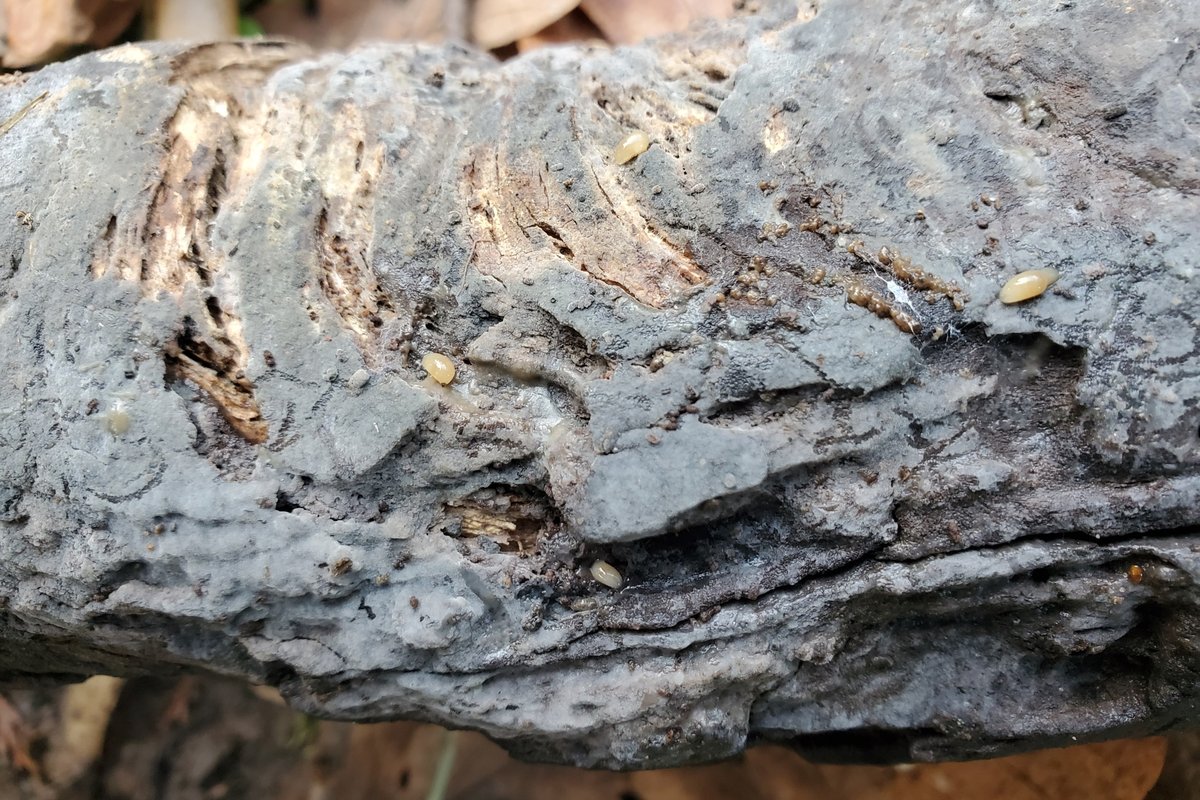
Basidiocarp (Scott Fitzgerald, iNat330439060)

Basidiocarp (Scott Fitzgerald, iNat330439060)

Simple-septate hyphae

Saccate probasidium

Saccate probasidia

Twisted and curved heterobasidia with developing basidiospores

A different focal plane of the same heterobasidia

An old, collapsed basidium

Basidiospores
Helicogloea sp. 'OR01'
Helicogloea is an obscure genus of crusts in the rust-fungus subphylum Pucciniomycotina. You might be most familiar with Helicogloea compressa, which is frequently found in its asexual form as light-colored pustules (sporodochia) on wood. The genus is otherwise composed primarily of rare and poorly studied species that produce thin crusts with a waxy to gelatinous consistency. Upon drying, many of these crusts become literally invisible, making study of fungarium material difficult. Microscopically, Helicogloea crusts are simple septate, without cystidia, have saccate (sac-like) probasidia (diagnostic of the Atractiellomycetes), and produce very cool septate basidia with lateral sterigmata (characteristic of Pucciniomycotina fungi). There are 28 species accepted in the genus Helicogloea (Liu et al. 2025, Malysheva et al. 2020, Spirin et al. 2018). Species in the closely related genera Saccosoma and Bourdotigloea differ in having clamped hyphae or cystidia.
The documented specimen was found growing on the underside of a rotten deciduous branch. Its morphology and ITS sequence data indicate it belongs to the lineage including H. aquilonia, H. exigua, H. pellucida, and H. sebacea, but the ITS is distinct (< 96% similar) from all other documented Helicogloea specimens, and it likely represents an undescribed species. Awaiting further collections, the provisional species code Helicogloea sp. 'OR01' has been created for it.
Thanks to Scott Fitzgerald and Bruce McCullough for collecting this specimen and facilitating its study.
Details
Presumably saprotrophic, growing on the underside of rotten deciduous branches.
Effused, smooth, with a gelatinous consistency, greyish; drying to a thin, invisible waxy coating.
Not determined.
Not determined.
Not determined.
Known from a single sequenced collection from Oregon, USA. View all sequenced specimens on iNaturalist.
Microscopy
Hyphal system: Monomitic, simple septate, hyphae (2.2) 2.5–3.6 (3.9) µm wide (n = 10). Probasidia: saccate (sac-like) with prominent oily contents. Basidia: Few observed, tubular-clavate, twisted or curved, about 5 µm wide, length not determined; septate with four lateral sterigmate (of the typical Pucciniomycotina type), sterigmata 4.5–6.5 µm long (n = 10); basidia collapsing at maturity. Basidiospores: Ellipsoid, repetitive, length (7.3) 7.9–9.6 (10.3) µm, width (4.9) 5.4–6.3 (6.7) µm, x̄ = 8.7 ✕ 5.9 µm; Q (1.2) 1.4-1.6 (1.7), x̄ = 1.5 (n = 30). Sterile structures: Absent.
Studied Specimens
ACD0795 (iNat330439060). 30 November 2025, coll. Scott Fitzgerald, on deciduous branch. Corvallis, Benton County, OR, USA, 44.5509, -123.2701. Sequences: available at iNaturalist (ITS).
References
-
Liu S-L, Zhao P, Cai L, Shen S, Wei H-W, Na Q, Han M, Wei R, Ge Y, Ma H, Karunarathna SC, Tibprommab S, Zhang B, Dai D, Lin L, Fan X-L, Luo Z-L, Shen H-W, Lu L, Lu W, Xu R-F, Tohtirjap A, Wu F, Zhou L-W. 2025. Catalogue of fungi in China 1. New taxa of plant-inhabiting fungi. Mycology 16:1–58. Link
-
Malysheva V, Spirin V, Schoutteten N, Lange RD, Pennanen J, Larsson K-H. 2020. New and noteworthy species of Helicogloea (Atractiellomycetes, Basidiomycota) from Europe. Annales Botanici Fennici 57:1–7. PDF Link
-
Spirin V, Malysheva V, Trichies G, Savchenko A, Põldmaa K, Nordén J, Miettinen O, Larsson K-H. 2018. A preliminary overview of the corticioid Atractiellomycetes (Pucciniomycotina, Basidiomycetes). Fungal Systematics and Evolution 2:311–340. PDF Link
Citation
Dirks, Alden. 2026. Species profile for Helicogloea sp. 'OR01'. CrustFungi.Com. https://crustfungi.com/species/helicogloea-sp-or01/. Accessed 2026-04-01.