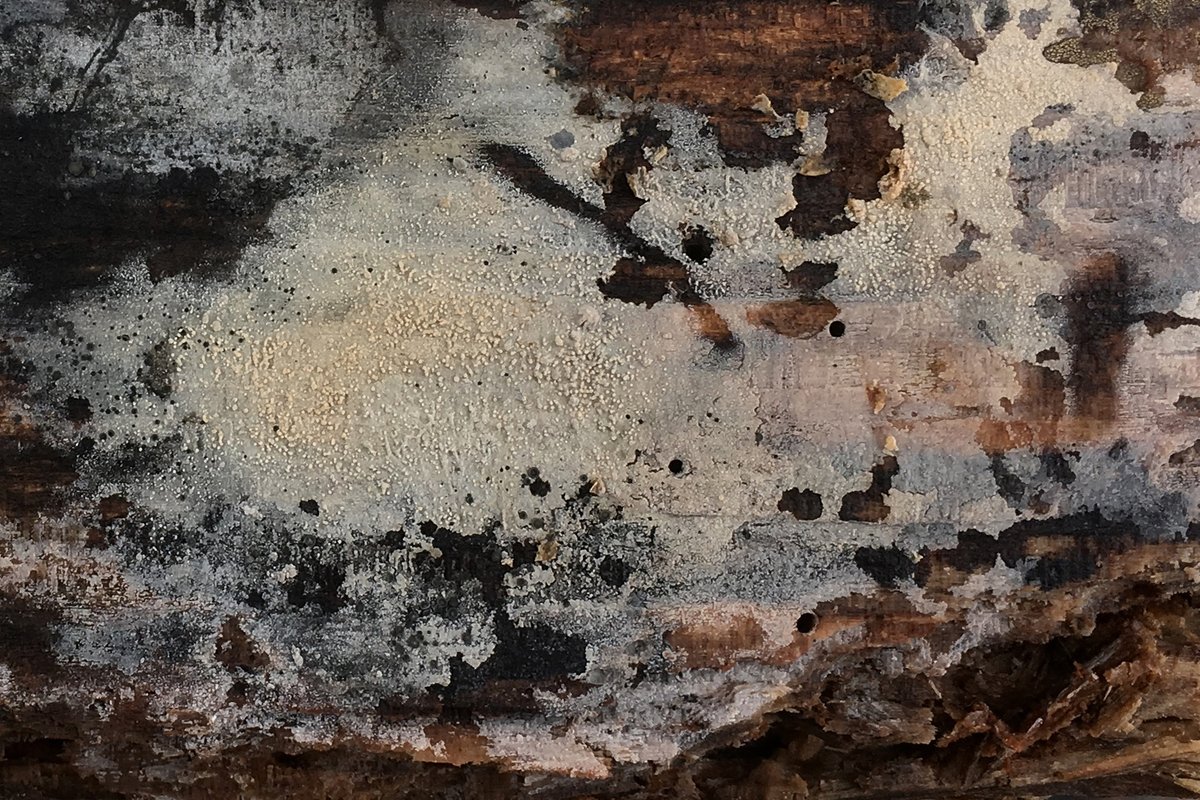
Basidiome

Basidiome
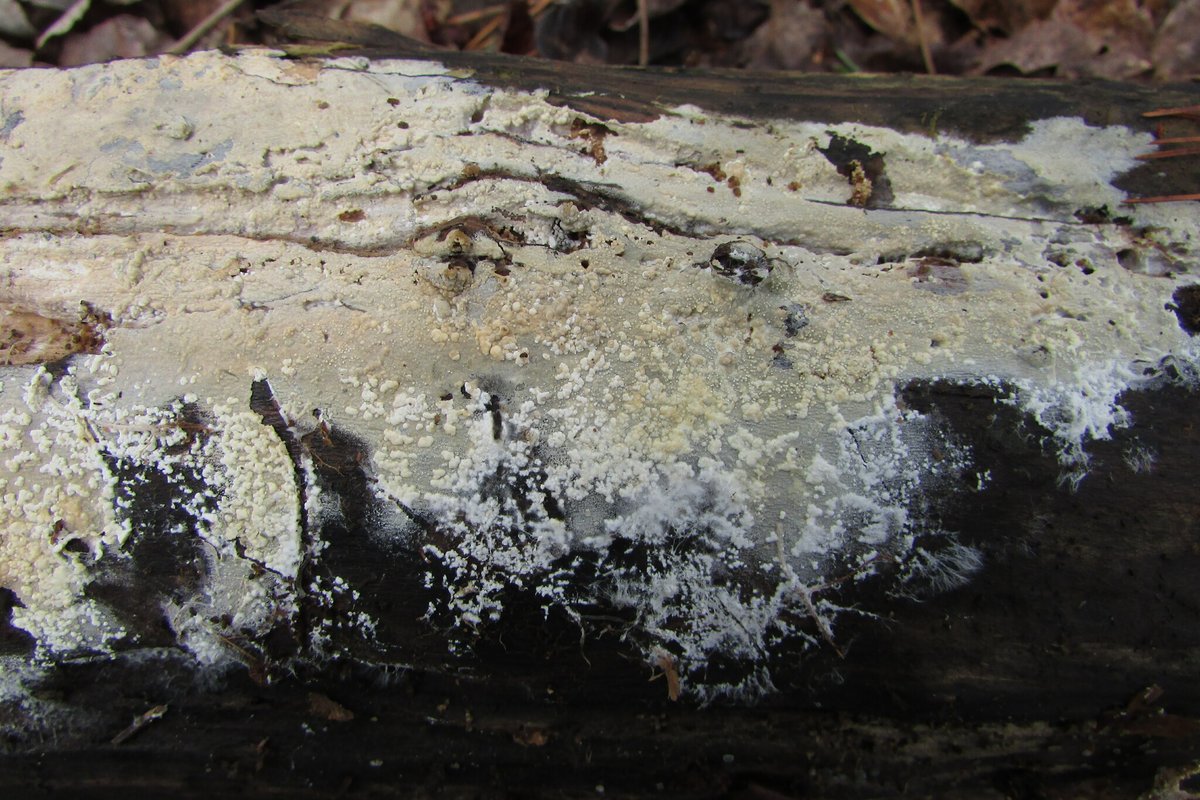
Basidiome (Maricel Patino, iNat152730682)

Cracked basidiome (Alden Dirks, iNat78264062)
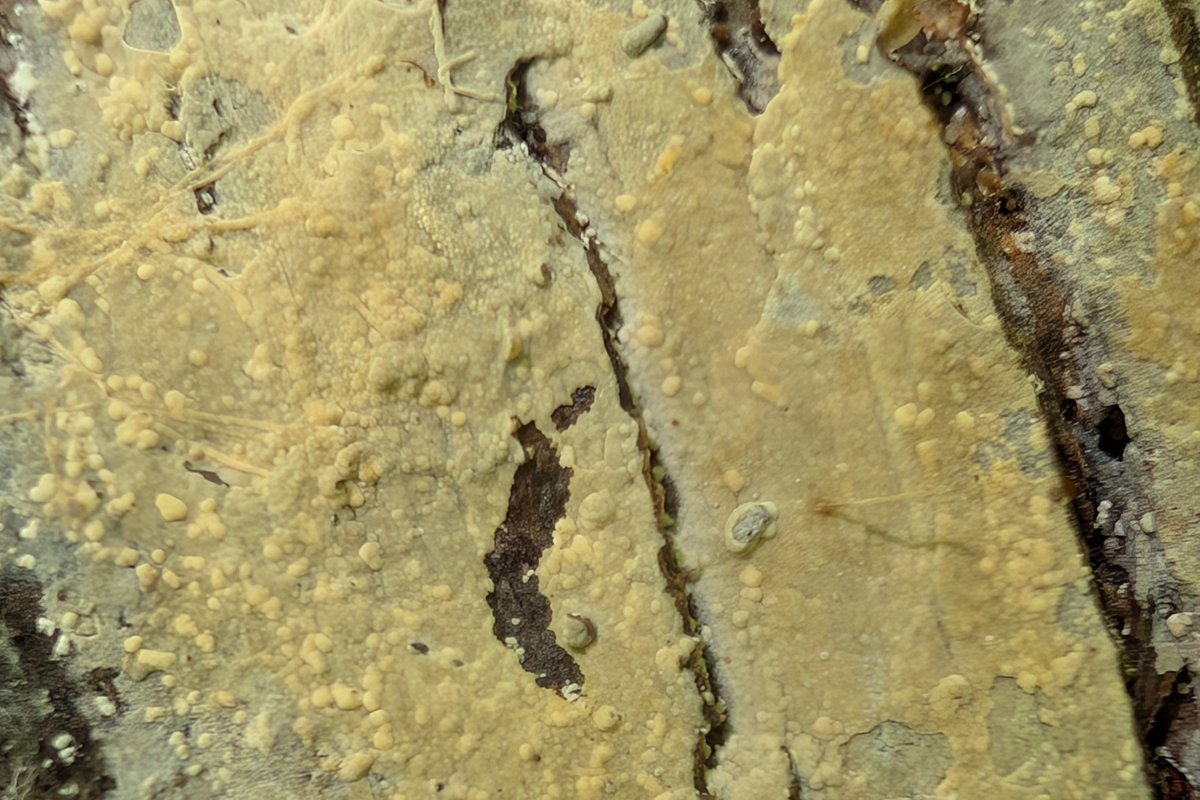
Yellow basidiome (Kevin Young, iNat280316970)

Basidia with 6 sterigmata and small oil droplets in the generative hyphae

Narrowly cylindrical basidiospores

Hyphae filled with guttules
Sertulicium granuliferum (Hallenb.) Spirin & Volobuev


Crusts in the genus Sertulicium are overall quite simple with thin, pale, and powdery to waxy basidiocarps and microscopic features generally not worth writing home about (Spirin et al. 2021). Their one claim to fame is having basidia with up to six sterigmata, an instant tipoff that you may have species in the Sistotrematales. Sertulicium granuliferum is unique in the genus for being a bit more robust and having hyphae that are full of small oil drops called guttules. Superficially, the creamy white sporocarp is impossible to differentiate from the many other similar looking crusts, especially given its variable appearance, so this group definitely requires microscopy for a positive ID.
Sistotremastrum guttuliferum is a synonym.
Details
Saprotrophic on wood remnants of deciduous trees.
Cream-colored to yellowish, resupinate, effused basidiome with a smooth to papillate hymenophore and indeterminate, pruinose margin; somewhat ceraceous when fresh, sometimes cracked like tiles, becoming cracked and membranaceous when dry.
Not determined.
Not determined.
Not determined.
Documented from Eastern North America and across temperate Eurasia. View all sequenced specimens on iNaturalist.
Microscopy
Hyphal system: Monomitic, all septa clamped; subicular hyphae somewhat thick-walled, width (3.6) 3.9–5.1 (5.3) µm, x̄ = 4.5 µm (n = 10), cytoplasm filled with small oil drops. Basidia: Clavate, sometimes with a slight constriction at the waist, with four to six sterigmata; length (16.6) 17.6–20.8 (22.0) µm, width (6.0) 6.2–7.0 (7.2) µm, x̄ = 19.2 ✕ 6.6 µm (n = 10); sterigmata lenth (4.6) 4.8–5.5 (5.6) µm, x̄ = 5.1 µm (n = 10), shriveling up as the basidia age. Basidiospores: Narrowly cylindrical, inamyloid; length (6.2) 6.5–8.1 (9.3) µm, width (2.5) 2.7–3.1 (3.2) µm, x̄ = 7.3 ✕ 2.9 µm, Q (2.1) 2.2-2.8 (3.6), x̄ = 2.6 (n = 30). Sterile structures: Absent.
Studied Specimens
BHI-F0755 (iNat172302119). 29 March 2017. Webb Memorial State Park, Boston Harbor Islands National Recreation Area, Suffolk Co., MA, USA, 42.2592 -70.9243. Kriebel Fungarium (PUL00047239). Sequences: MW488061 (ITS), MW488062 (ITS).
References
-
He M-Q, Cao B, Liu F, Boekhout T, Denchev TT, Schoutteten N, Denchev CM, Kemler M, Gorjón SP, Begerow D, Valenzuela R, Davoodian N, Niskanen T, Vizzini A, Redhead SA, Ramírez-Cruz V, Papp V, Dudka VA, Dutta AK, García-Sandoval R, Liu X-Z, Kijpornyongpan T, Savchenko A, Tedersoo L, Theelen B, Trierveiler-Pereira L, Wu F, Zamora JC, Zeng X-Y, et al. 2024. Phylogenomics, divergence times and notes of orders in Basidiomycota. Fungal Diversity 126:127–406. Link
-
Liu S, He S, Wang X, May T, He G, Chen S, Zhou L. 2022. Trechisporales emended with a segregation of Sistotremastrales ord. nov. (Basidiomycota). Mycosphere 13:862–954. PDF Link
-
Spirin V, Volobuev S, Viner I, Miettinen O, Vlasák J, Schoutteten N, Motato-Vásquez V, Kotiranta H, Hernawati, Larsson K-H. 2021. On Sistotremastrum and similar-looking taxa (Trechisporales, Basidiomycota). Mycological Progress 20:453–476. PDF Link
Citation
Dirks, Alden. 2026. Species profile for Sertulicium granuliferum (Hallenb.) Spirin & Volobuev. CrustFungi.Com. https://crustfungi.com/species/sertulicium-granuliferum/. Accessed 2026-04-04.