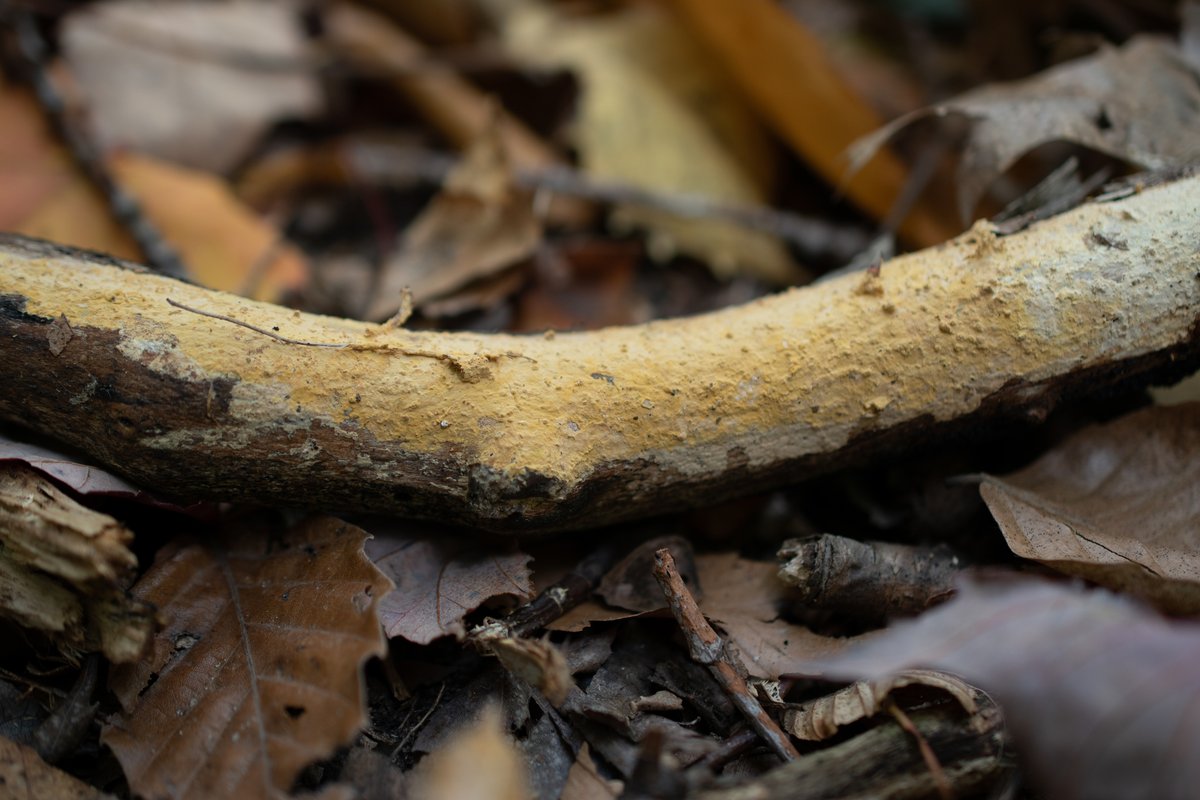
Straw yellow to golden basidiocarp

Reddish brown reaction from ammonia and KOH

Basidiocarp (Huafang Su, iNat256502551)

Basidiocarp (John Plischke, iNat258984260)

Likely clamp connection on a generative hypha

Ellipsoid-fusoid basidiospores

The extension on the spore tip is amyloid

Needle-like dichohyphidia

Gloeocystidium
Vararia investiens (Schwein.) P. Karst.


The genus Vararia, which contains about 82 species, is common in the subtropics and tropics but less diverse in temperate areas (Deng et al. 2024). Vararia investiens was described (as Radulum investiens) from Pennsylvania by Schweinitz in 1832 and is frequently encountered in Northeastern North America. Growing on the underside of deciduous branches and sticks, this crust is recognizable by its distinct yellow color and velutinous aspect. Any doubts about ID are quickly dispelled with microscopy — the stunning dichohyphidia and prominently pointed ellipsoid-fusoid basidiospores are quite unique.
Vararia basidiomata have an interesting development whereby the basidia and cystidia originate deep within a blanketing hyphidial hymenium and elongate through it but are constantly overgrown by expanding hyphal elements. As a result, basidia and basidiospores are found embedded within the basidiocarp at all levels and are difficult to discern among the jungle of needley dichohyphae (Lentz and McKay 1965).
Details
Saprotrophic on hardwood sticks.
Effused, straw yellow to golden in color, even to tuberculate, membranaceous to chalky-crustaceous (reminiscent of felt), growing over and agglutinating small debris to the substrate, margin abrupt.
Not determined.
Ammonia and KOH turning the yellow hymenium reddish brown; iron salts not absorbing (effectively negative).
Not determined.
Northeastern North America. View all sequenced specimens on iNaturalist.
Microscopy
Hyphal system: Dimitic; generative hyphae with difficult-to-discern clamp connections, embedded deep within a thicket of acicular (needle-like) dichohyphae or dichohyphidia; dichohyphae thick-walled, weakly dextrinoid, yellowish in KOH, profusely branched, extending from the substrate to the hymenium and beyond, seemingly constituting the entire subiculum, width (1.9) 1.9–2.8 (3.2) µm (n = 10); I observed a few enormous and thick-walled seta-like dichohyphida with one or more central hyphae running the interior length, a characteristic mentioned briefly by Lentz and McKay (1965). Basidia: Difficult to find within the thicket of dichohyphidia; utriform with four sterigmata. Basidiospores: Narrowly cylindrical, fusoid or pip-shaped (like an apple seed), more accurately geniculately fusoid-ellipsoid; smooth, thin-walled, hyaline, inamyloid, with a prominently pointed (pseudo)septate amyloid tip (deemed a "suprahilar plage" or "plaque") that does not stain with phloxine B; length (8.8) 9.6–11.5 (12.5) µm, width (3.3) 3.6–4.3 (5) µm, x̄ = 10.6 ✕ 3.9 µm, Q (2.2) 2.4-3 (3.3), x̄ = 2.7 (n = 30). Sterile structures: Gloeocystidia present, about 5–7 µm wide, up to 50 µm long.
Studied Specimens
ACD0382 (iNat62862821). 17 October 2020. Nan Weston Preserve, Washtenaw Co., MI, USA, 42.1856 -84.1111. University of Michigan Fungarium (MICH352290). Sequences: MZ919258 (ITS).
ACD0543 (iNat130261019). 10 August 2022. French Creek State Park, Chester Co., PA, USA, 40.2051 -75.7361. University of Michigan Fungarium. Sequences: OP508177 (ITS), OP596486 (LSU).
References
-
Deng Y, Jabeen S, Zhao C. 2024. Species diversity and taxonomy of Vararia (Russulales, Basidiomycota) with descriptions of six species from Southwestern China. MycoKeys 103:97–128. PDF Link
-
Lentz PL, McKay HH. 1965. Delineations of forest fungi: morphology and relationships of Vararia. Mycopathologia et Mycologia Applicata 29:1–25. PDF Link
Citation
Dirks, Alden. 2026. Species profile for Vararia investiens (Schwein.) P. Karst. CrustFungi.Com. https://crustfungi.com/species/vararia-investiens/. Accessed 2026-04-04.